

Get to know some of the winners of the 2025 International Linguistics Challenge. We have asked them about their interests, inspirations, hobbies and future plans. You can find their details and answers below.


Why are you interested in linguistics in general?
I find it very interesting how all the different cultures of the world, originating on different continents across the globe can have dialects so different from each other, and yet inevitably share common morphological and syntactical similarities with even their most distant neighbours. I think linguistics is a perfect reminder for us in the modern day how no matter where we comes from, there always exists some point of common ground between us.
Do you think you have gained something from participating in ILC?
Absolutely. While I've participated in similar competitions before, I found that the nature of the ILC this year challenged me in a way I found particularly enriching. Of note, I found that questions in the relevant rounds related to the analysis of scientific text were a great way for me to develop my critical analysis skills, as well as to further progress my capability with effective planning.
What is your favourite linguistics fact or phenomenon?
Building on what I said earlier, I find linguistic universalism intriguing. That is, how different cultures unrelated to one another can, seemingly, develop similar sounding words for similar concepts (for example, how many languages have similar sounding words for "mom" and "dad"). I find Greenberg's linguistic universals an interesting bridge into this topic.
Do you have plans for your future study career?
Absolutely. While not entirely related to linguistics, I hope to go into physics research in my professional career. However, after my success in this competition, I may have to consider integrating linguistic study somewhere into my university curriculum, or potentially even beyond!


Why are you interested in linguistics in general?
From a young age, I have always been interested in puzzles, such as ciphers. In a way, every language is something to decipher, because each has its own underlying logical system. Understanding linguistic concepts helps a lot when learning new languages — but also in other aspects of life. When studying something else, be it maths or chemistry, it is always fun to look up the etymology of some of the most used terms in various languages, and hence also remember them better.
Do you think you have gained something from participating in ILC?
I have been participating in linguistics olympiads for some time now, including the IOL, but the ILC has its own format: while other competitions rely solely on logical thinking and problem-solving skills, the ILC, especially when preparing for the final round, encouraged me to research the actual terms used by linguists to describe linguistic phenomena. But perhaps the most interesting part was the analysis of a real scientific article, preparing me for a possible life later in academia.
What is your favourite linguistics fact or phenomenon?
A part of linguistics that especially excites me is the interaction between languages, e.g. when words and structures are borrowed, often undergoing various processes. These include clear misinterpretation, like the French vasistas, meaning ‘transom window’ (from German Was ist das?, meaning ‘what is that?’) and Lochmere Lake (supposedly lit. ‘Lake Lake Lake’), and reanalysis, like in the Swahili kitabu ‘book’, borrowed from Arabic, but reinterpreted as ki-tabu, yielding the plural form vi-tabu.
Do you have plans for your future study career?
I am planning to pursue a bachelor’s degree in mathematics and computer science, and then to see how it goes. However, I would like for linguistics to be a part of my life as well — possibly in a combination through work and research in machine learning and natural language processing.


Why are you interested in linguistics in general?
I have always loved learning languages, so at some point I started taking an interest in how those languages work, what they have in common or how they differ. The complex systems of the world's languages fascinate me and there's so much to learn and explore.
Do you think you have gained something from participating in ILC?
Apart from the awards and the bragging rights I earned, it was just an interesting experience and I learned a couple new things in the process. I do think I will participate again next year, hopefully to get another great result.
What is your favourite linguistics fact or phenomenon?
I find untranslatable words really interesting: words that perfectly describe a thing or a concept in one language that just have no equivalent in another, where the only thing close to a translation would be a tedious description, and even that won't convey that specific feeling.
Do you have plans for your future study career?
I do have some ideas about what I could do after school, but there are just too many options to choose from and unfortunately I can't pursue them all. Luckily I still have some time until I finish school, so I'm probably going to postpone the decision-making until then.
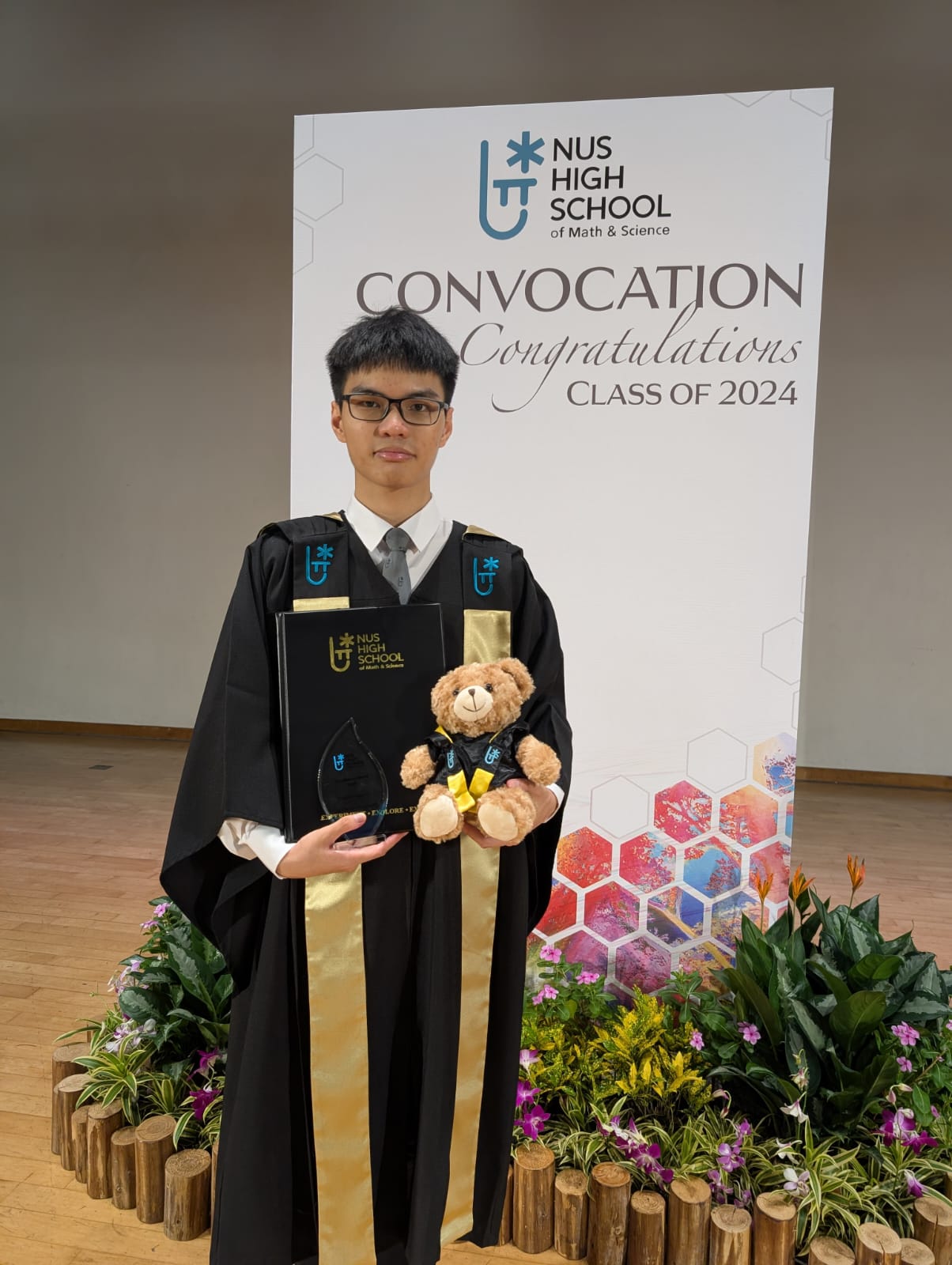

Why are you interested in linguistics in general?
Growing up in Singapore, I was surrounded by four languages: English, Mandarin, Malay and Tamil. I say signs written in all four languages, and this sparked my interest in finding out how other writing systems around the world looked and worked. In secondary school, I was introduced to linguistics olympiads, and from there, I was hooked. Though the olympiad problems are small and self-contained, they gave valuable and deep insights as to how various cultures parsed the world around them.
Do you think you have gained something from participating in ILC?
I am heartened to see people from so many diverse backgrounds and countries come together to participate in the ILC. It makes me happy to know that the joy I have gained through studying linguistics is shared with so many other like-minded peers around the world.
What is your favourite linguistics fact or phenomenon?
Did you know that all of Singapore's four official languages are completely unrelated, so no two of them share any common ancestor? English is Indo-European, Mandarin is Sino-Tibetan, Malay is Austronesian, and Tamil is Dravidian. This goes to show the linguistic diversity of my home country. In addition, dialects like Hokkien and Cantonese are also spoken by the older generation. Being surrounded by such linguistic diversity probably shaped my interest in linguistics since I was young.
Do you have plans for your future study career?
Currently, I am planning to study chemical engineering in university. Besides linguistics, chemistry and physics were my strong suits in school, so I feel that chemical engineering is a choice suited for me. However, I will continue to pursue my passion for linguistics in other avenues, such as problem-setting.


Why are you interested in linguistics in general?
One thing that has always drawn me to linguistics is its interdisciplinary nature: the field asks us to study language, an object usually thought of humanistic terms, using formal tools associated with the hard sciences. To understand something like Korean grammar, one must employ generative syntax's technical system of trees & transformations; at the same time, one cannot neglect cultural & historical factors like Korean social structure or long-term contact with speakers of Sinitic languages.
Do you think you have gained something from participating in ILC?
In one problem set, ILC posed a series of questions which essentially involved documenting an unknown language. Working from nothing but raw data, I was challenged to phonetically transcribe words and sentences, spot intricate morphosyntactic patterns, and make observations about dialectal variation.
As I had never before engaged in linguistic field work, this was definitely a unique experience, and it has encouraged me to explore language documentation more in the future.
What is your favourite linguistics fact or phenomenon?
My favorite linguistic phenomenon is probably Mayan agent focus. Like Chukchi, Dyirbal, and many other languages, the Mayan family prohibits transitive subjects from undergoing several operations grouped under the label of "A' bar extraction." However, the Mayan languages are unique in that their ban on A' extraction is not absolute; it is conditional, and can be circumvented with the use of a special verb form called "agent focus."
Do you have plans for your future study career?
I recently committed to Stanford University, where I will study theoretical linguistics and pure math in the fall after graduating from secondary school. With my education, I hope to research the mathematical structures that underlie human language, and to fight against the ever-growing problem of language death.

Why are you interested in linguistics in general?
I am interested in linguistics because first of it is a very interesting subject. Linguistics might seem like a far off subject but actually it is really intertwined with our lives.
I have myself even written and published a paper on linguistics.
When I was a kid, I remember researching and trying to decode the 'mysterious' manuscripts like the Voynich Manuscript and Rohonc Codex and I believe that has also played a big part in forging my interest in this field.
Do you think you have gained something from participating in ILC?
I believe yes, as this was my first linguistics competition, I solved a variety of questions in my practice and in the exam itself.
I gained more aptitude and confidence in this field.
What is your favourite linguistics fact or phenomenon?
I think the fact that how we can construct an ancient language even though we have no information about it just be using its descendants and related languages.
Do you have plans for your future study career?
I don't have any one set future study career plan but I have many options. Either I can work in the field of science and technology, maybe history economics or political science or I can join civil services.
Whatever I do, I want to make sure that my job or my work makes an impact on the people.

Why are you interested in linguistics in general?
I'm majorly interested in linguistics because I enjoy understanding patterns, meaning, and communication deeply. As a data science student who speaks English, Hindi, Telugu, French and is learning more Indian languages, I appreciate how language works structurally and culturally. Linguistics connects logic, human behaviour, and AI, aligning with my curiosity, compassion, and desire to create knowledge that helps people.
Do you think you have gained something from participating in ILC?
Definitely, I have gained a lot. Participating in ILC introduced me to linguistics, a field I didn’t even know existed. While I always loved languages, I had never understood the deep logic and structure behind them. Preparing for this challenge from available resources online on my own, helped me discover the many branches of linguistics and showed me how languages follow fascinating patterns, greatly enriching my perspective.
What is your favourite linguistics fact or phenomenon?
I was especially fascinated by sound symbolism. Many studies suggest that sound symbolism and arbitrariness can coexist within a language, revealing that linguistic meaning may not be entirely random. This insight makes me wonder whether there was ever a time when humanity shared a common language shaped by such patterns. The idea that sounds might carry traces of shared human perception deeply intrigues me, and I hope to explore this question further through my own research in the future.
Do you have plans for your future study career?
I have clear and purposeful plans for my academic future. I am pursuing a BS in Data Science and Applications from IIT Madras, with a strong interest in machine learning, especially in the healthcare sector. I aspire to pursue a PhD and contribute to impactful research. Inspired by ILC, I am also exploring linguistics, particularly sound symbolism. Alongside this, I hope to meaningfully influence Indian polity as I continue striving to serve society with integrity and dedication.


Why are you interested in linguistics in general?
Language at first seems like this arbitrary and illogical thing to most people and it's really fascinating to see that it still has underlying principles and logic despite being so inherently human.
Do you think you have gained something from participating in ILC?
Yes, this is the first time I've ever been able to use or showcase my linguistics knowledge and it's been a very positive experience.
What is your favourite linguistics fact or phenomenon?
I love declensions. I know this is probably a really unpopular opinion but I just really love how Indo-European languages like Icelandic and Latin decline their nouns and adjectives there's a weird sense of satisfaction I get from memorizing all these different inflections and using them in sentences.
Do you have plans for your future study career?
Not exactly but I do know I would ideally want to incorporate at least one of my two passions, music and languages.


Why are you interested in linguistics in general?
Ever since younger, I've had a notable interest in foreign languages, even it it was just for the alphabets and simpler words. Russian, Armenian, Greek, Georgian, you name it. Maybe pattern recognition did some of the work too? At some point, I even decided to construct my own artificial languages, including my very own Twastoni (though it's a project I'm yet to finish creating, with the rest of the language's universe's worldbuilding).
Do you think you have gained something from participating in ILC?
During ILC, I believe I have gained experience and a bit of knowledge I still didn't quite have before from participating in a competition of this scale. Of course, I would be lying if I said that I didn't atleast have some fun in each part of the competition, too.
What is your favourite linguistics fact or phenomenon?
Right now, I imagine I have to say: many know that the languages Malagasy from Madagascar and Rapa Nui from Easter Island are part of the same family tree, Austronesian, but how many do know that this group most likely originated from the island of Taiwan? Maybe I've just found out about this pretty lately, but taking in consideration the position of that origin in relation to all of the places where these languages are spoken, it's still quite the surprise.
Do you have plans for your future study career?
As for plans, while I possess a firm interest in linguistics, I say I'm choosing to focus on general sciences, mainly biology/medicine, looking to the future. In fact, as linguistics and biology cross in more than one way (cognitive functions, genetics, structural patterns and laws, among others), it would be possible to utilize the former in many ways for a goal of creating a technology that helps humanity itself by a great extent, which is, ultimately, a goal I wish to meet in my own journey.